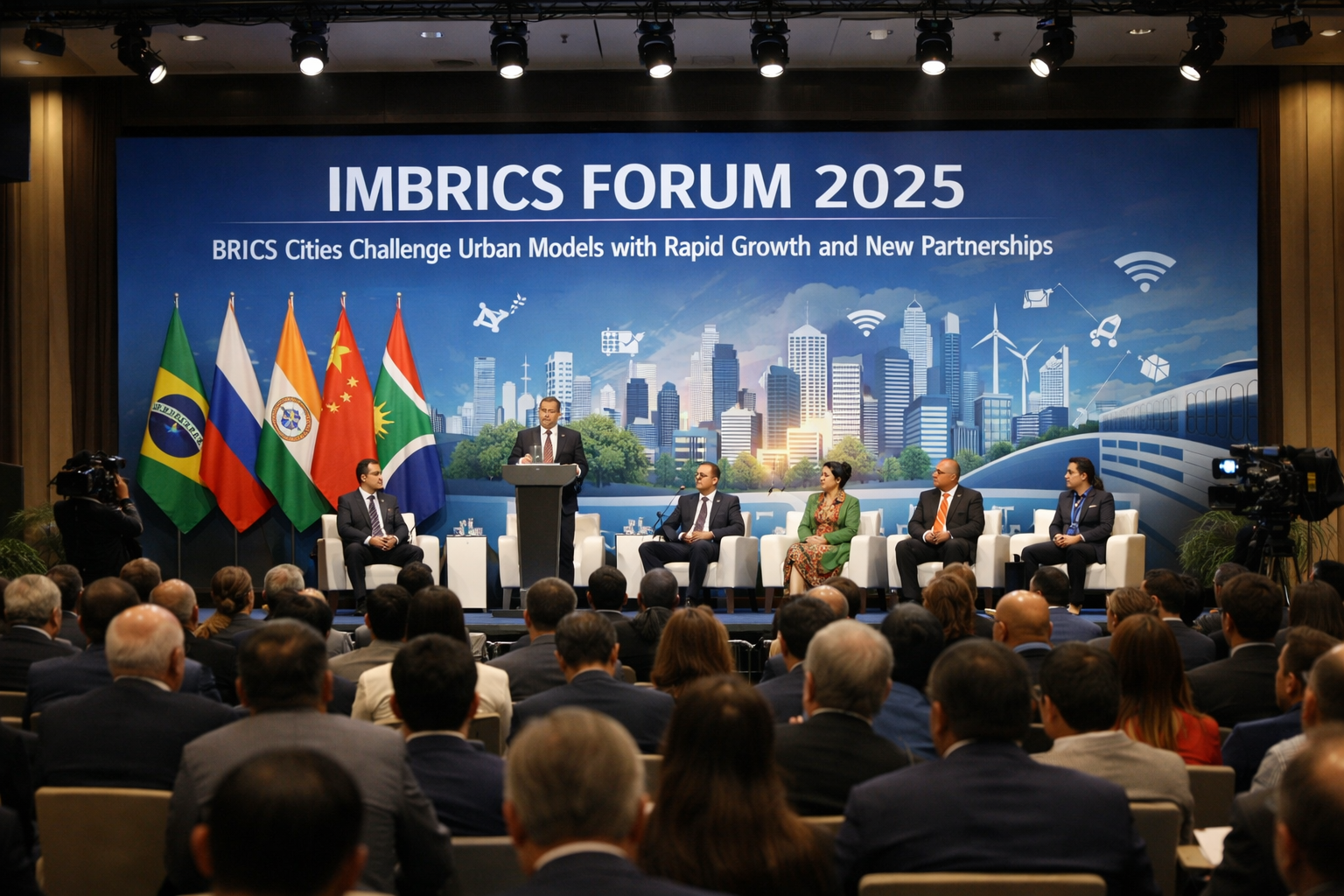
The IMBRICS Forum 2025 has become a key international platform for discussing how cities in BRICS countries are transforming under the pressure of rapid urbanization, technological change, and shifting global partnerships. As megacities and fast-growing urban centers across Brazil, Russia, India, China, and South Africa continue to expand, traditional urban development models are being tested. The forum highlights how these cities are not only facing common challenges, but also creating new approaches that may redefine urban growth worldwide.
Urban Growth as a Shared Challenge
Cities within the BRICS framework are experiencing unprecedented demographic and economic growth. Millions of people are moving to urban areas each year in search of jobs, education, and better living standards. This growth puts immense pressure on housing, transport systems, healthcare, energy supply, and environmental sustainability. At IMBRICS Forum 2025, participants emphasize that copying Western urban models no longer works in contexts where population density, social inequality, and infrastructure gaps are fundamentally different.
Instead, BRICS cities are experimenting with hybrid solutions that combine large-scale public planning, digital governance tools, and local community initiatives. The discussion focuses on adapting cities to growth without losing social balance, cultural identity, and economic resilience.
New Urban Models and Innovation
One of the central themes of the forum is the emergence of alternative urban models designed specifically for rapidly developing economies. Smart city technologies play an important role, but speakers underline that technology alone is not enough. Data platforms, artificial intelligence, and digital public services must be integrated with inclusive policies and long-term planning.
Particular attention is given to urban mobility, affordable housing, and climate adaptation. BRICS cities are increasingly investing in public transport, mixed-use neighborhoods, and green infrastructure to reduce environmental risks. The forum demonstrates that innovation in these cities often happens faster than in more mature urban systems, precisely because there is an urgent need to solve problems at scale.
Key priorities discussed at IMBRICS Forum 2025 include:
- development of affordable and high-density housing without reducing quality of life
- integration of digital governance to improve public services and transparency
- creation of resilient infrastructure adapted to climate change
- support for local economies and small businesses within urban ecosystems
Partnerships Beyond Borders
Another important outcome of the IMBRICS Forum 2025 is the growing role of international and intercity partnerships. BRICS cities are increasingly cooperating directly with each other, exchanging expertise, technologies, and investment models. This city-to-city diplomacy allows urban leaders to bypass slow national frameworks and implement practical solutions more quickly.
The forum highlights partnerships with universities, private companies, and international organizations as drivers of sustainable urban transformation. These collaborations help cities attract funding, develop pilot projects, and scale successful initiatives across regions. As a result, BRICS cities are positioning themselves not just as followers of global trends, but as active contributors to new standards of urban development.
IMBRICS Forum 2025 shows that the future of global urbanization may be shaped in the cities of the Global South. By challenging outdated models and building new partnerships, BRICS cities are redefining how rapid growth can be managed in a more inclusive, innovative, and sustainable way.